
Overview
In his most recent interview with the Iraqi News Agency (INA), the Prime Minister of Iraq presented a set of new economic figures that carry significant implications for the country’s financial outlook. However, these figures diverge markedly from the data published in official reports issued by the Ministry of Finance, the Central Bank of Iraq, and various international institutions.
According to the Prime Minister, Iraq’s domestic debt amounts to 34 trillion Iraqi dinars, while external debt stands at 13 trillion dinars (approximately USD 10.056 billion), bringing the country’s total debt to 47 trillion dinars.
By contrast, data released by the Ministry of Finance and the Central Bank of Iraq indicate that, as of end-June 2025, Iraq’s total debt reached 106 trillion dinars, comprising 87 trillion dinars in domestic debt and 18.7 trillion dinars in external debt. This substantial discrepancy raises important questions regarding data consistency and transparency in the reporting of Iraq’s financial position.
Secondly, there is a significant quantitative imbalance between the public and private sectors. While cumulative private-sector investment has exceeded USD 100 billion, the public sector workforce has expanded sharply over the same period. Within just two and a half years, approximately one-fifth of the current public-sector employees have been added to government payrolls. Under the three-year federal budget framework, the total number of public-sector employees—including those in the Kurdistan Region—was projected at 4,074,697. However, this figure has since risen to approximately 4.55 million, indicating that nearly 500,000 new employees have been absorbed into the public sector within two years and five months. This rapid expansion has occurred despite substantial capital inflows into the private sector, raising questions about the effectiveness of private investment in generating sustainable employment.
Here, we take the Prime Minister’s figures as an entry point for assessing Iraq’s financial position. Fluctuations—both increases and declines—in these indicators signal a potential shift in the country’s economic trajectory, from growth toward fragility. Such sharp movements in headline figures raise serious questions about data reliability and financial transparency.
Iraq’s Domestic and External Debt Figures in 2025
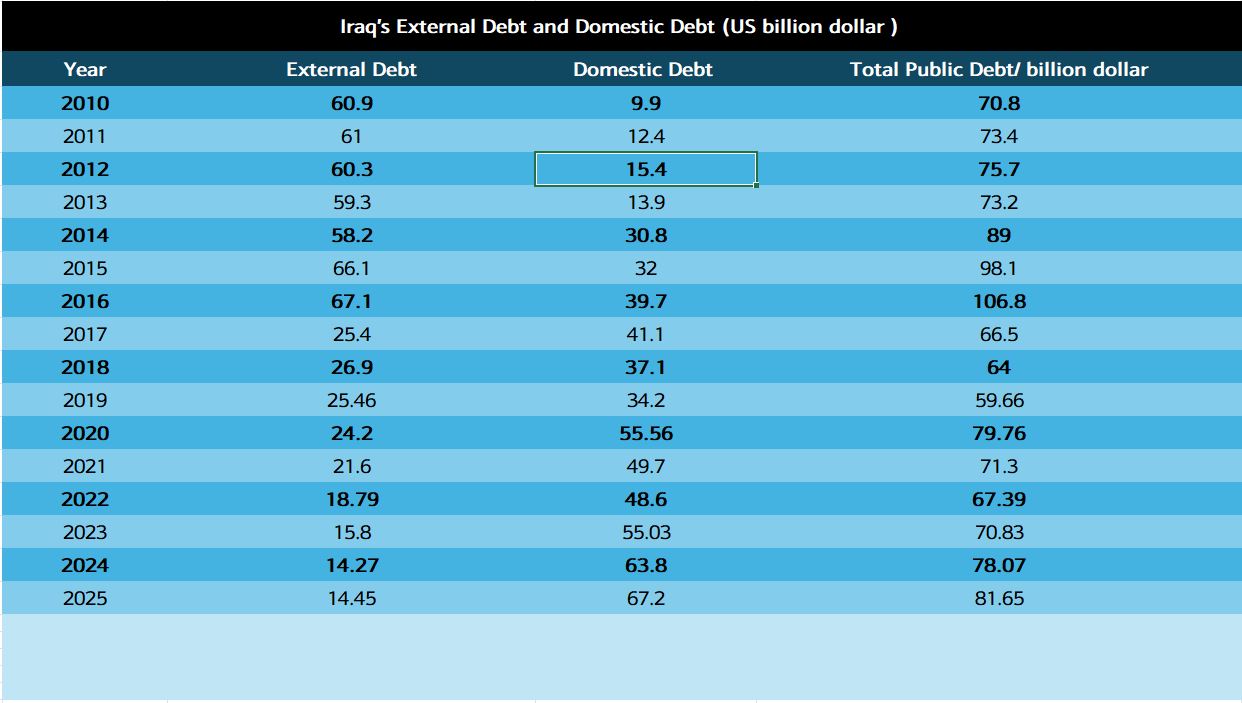
The Ministry of Finance’s online dashboard on Iraq’s domestic and external public debt—previously accessible on the official website and covering the period from 2010 through the end of June 2025—has recently been removed. Despite the dashboard’s disappearance, the debt data page that remained available up to the end of June 2025 provides detailed figures on Iraq’s debt stock. According to this data, Iraq’s external debt stood at 18 trillion and 789 billion Iraqi dinars, while domestic debt amounted to 87 trillion and 383 billion Iraqi dinars, as presented in the table below.
Furthermore, the Central Bank of Iraq (CBI), in its first-quarter financial monitoring report, indicates that total domestic public debt rose from IQD 73.25 trillion to IQD 85.54 trillion. This sharp increase signals a heightened risk of future financial pressure, particularly in the absence of structural adjustments to public finance management.
Maintaining the current financial trajectory necessitates a comprehensive reassessment of public expenditure policies, alongside the enforcement of stricter fiscal rules aimed at ensuring long-term financial sustainability. Central to this process is a reduction in Iraq’s structural dependence on oil revenues, which continues to undermine revenue diversification efforts.
However, according to the Ministry of Finance, during the first nine months of the year, Iraq’s total oil and non-oil revenues amounted to IQD 91.1 trillion, of which IQD 81.7 trillion was derived from oil exports—meaning that oil revenues accounted for approximately 90 percent of total revenues. By contrast, total public expenditures over the same period reached IQD 99.97 trillion, with IQD 85.4 trillion allocated to operational (current) spending and IQD 14.4 trillion directed toward investment (capital) expenditures.
Over the first nine months of this year, the gap between government expenditures and revenues—the fiscal deficit—exceeded 8.8 trillion Iraqi dinars (approximately USD 6.7 billion). In the corresponding period last year, the fiscal deficit surpassed 9.7 trillion dinars (around USD 7.5 billion).
Based on projected expenditures for the remaining three months of the year and estimated oil revenues for the full financial year, the deficit is expected to exceed USD 20 billion. This trajectory implies that debt will necessarily increase rather than decline, barring significant financial adjustment.
Table 1: Iraq’s Domestic and External Debt (2010–June 2025)
Iraqi Allocation Subsidies in 2024
According to the International Energy Agency (IEA), Iraq ranked fourth globally among countries providing energy-related financial subsidies. The country recorded an average subsidy rate of 27 percent, equivalent to $317 per capita, with total energy subsidies accounting for approximately 5.3 percent of GDP growth in 2024.
IEA estimates further indicate that Iraq’s total expenditure on oil, gas, and electricity subsidies reached $14.7 billion (IQD 19.11 trillion) in 2024. The oil sector absorbed the largest share, amounting to $8.3 billion, largely due to the sale of gasoline and diesel at prices up to eight times lower than international market levels. In addition, the government spent $4.47 billion on electricity subsidies. During the summer months, the Council of Ministers approved the provision of free diesel fuel to private electricity generators, a policy decision that increased total subsidy expenditures rather than reducing them over the course of the year.
From an economic and energy policy perspective, the International Energy Agency (IEA) highlights that continued financial subsidies for fossil fuels not only impose high fiscal and environmental costs but also distort market signals, leading to excessive demand and allocative inefficiency in energy consumption. Consequently, countries are urged to phase out fossil fuel subsidies as a priority measure to curb carbon dioxide (CO₂) emissions and promote efficient energy use.
Graph 1: Iraq’s Fossil Fuel Subsidies across Different Energy Sectors, 2010–2024

Conclusion
Iraq’s financial position continues to reflect a pattern of high public expenditures coupled with revenue volatility, largely tied to fluctuations in global oil prices. In practice, this means that when oil prices are elevated, government spending tends to increase, while declines in oil prices often force expenditure reductions. A recent illustration of this dynamic is the urgent meeting convened by the Supreme Economic Council, which resolved to both reduce and review expenditures for the current fiscal year. However, establishing a sound financial strategy remains challenging as long as accurate, consolidated data on revenues and expenditures from all relevant institutions are unavailable. Persistent discrepancies—reaching trillions of Iraqi dinars and billions of U.S. dollars—undermine transparency, complicate budget planning, and heighten fiscal risks.
The figures reported by Iraqi institutions contain significant discrepancies, creating not only uncertainty for the country and society but also obscuring the direction of future economic planning. For instance, there are notable inconsistencies in oil and non-oil revenue figures reported by the Ministry of Finance in its April and May 2025 reports. Similarly, in 2023, a $4 billion discrepancy existed in oil revenue between the Ministry of Finance and the Ministry of Oil. Furthermore, discrepancies in the reporting of domestic and external debt have reached 60 trillion Iraqi dinars.
This raises critical questions about Iraq’s fiscal sustainability. How can the country, in a context where financial subsidies are increasing and the budget deficit has tripled compared to two years ago, reduce both external and domestic debt? More fundamentally, why do figures reported by Iraqi institutions and officials regarding the country’s economic situation diverge so widely and remain inconsistent?