
Overview
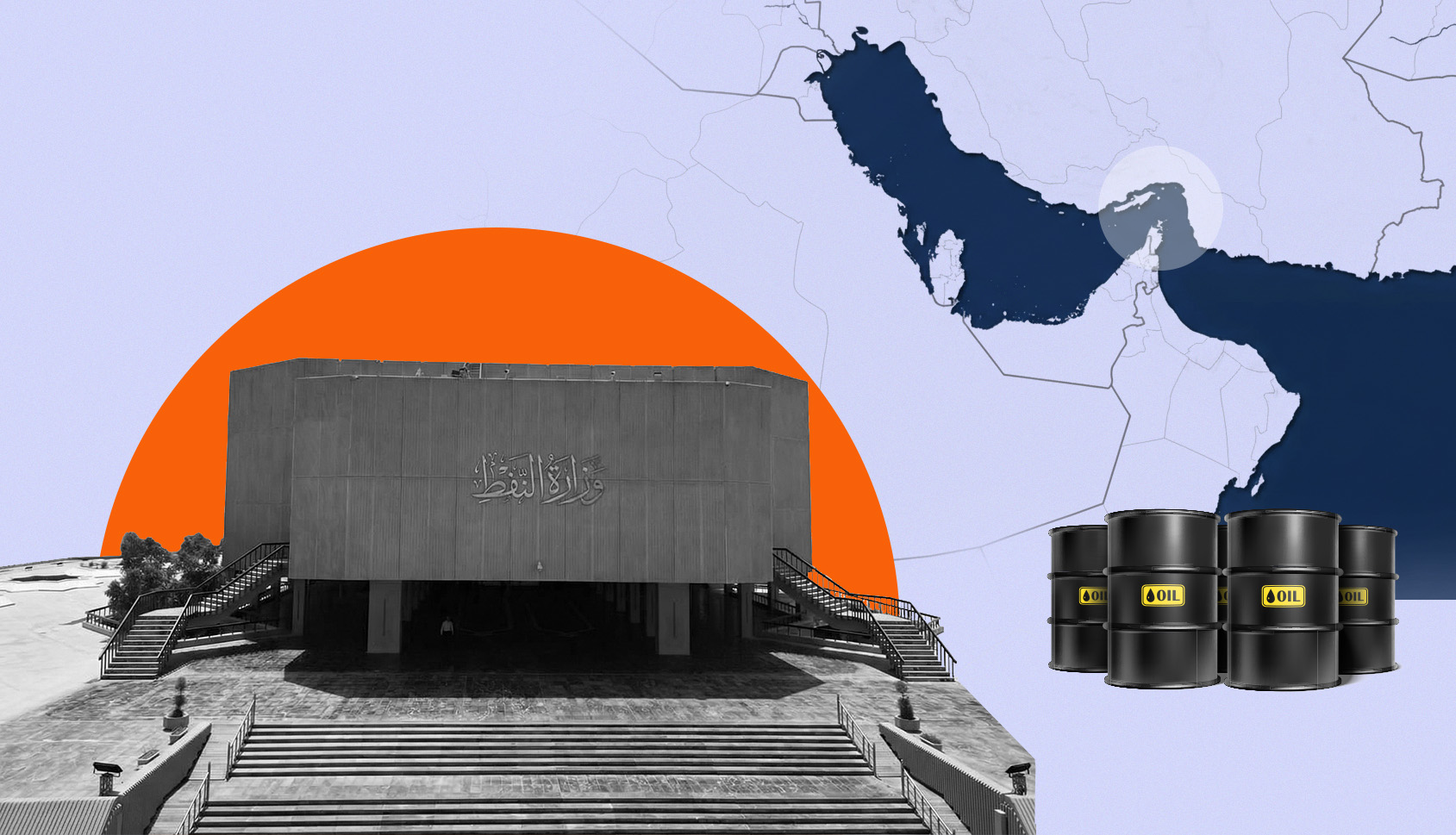
On Sunday, Iraq’s Ministry of Oil convened a high-level meeting to review recent regional developments and their implications for the energy market. Officials stated that the discussions included an evaluation of the emergency response plan for the oil sector, as well as strategies concerning production and export operations for crude oil, natural gas, and petroleum products, all in light of ongoing security tensions in the region.
One of the most serious scenarios under consideration is a disruption to ship traffic through the Strait of Hormuz. This narrow waterway remains a critical artery for global energy exports, with approximately one-fifth of the world’s oil supply passing through it daily. Iraq ranks as the second-largest exporter of crude oil via the Strait, after Saudi Arabia, making the route vital to its economy and to global markets.
Tensions in the region have steadily increased the risk to commercial ships and raised fears that the Strait of Hormuz could be partially or fully closed. Should such a closure occur, the consequences would be far-reaching—extending well beyond immediate price spikes. A complete halt in shipping through this chokepoint would significantly disrupt global energy flows, intensify market volatility, and undermine economic stability for both oil-producing countries and major importers worldwide.
For Iraq specifically, the impact would be particularly severe. The Iraqi economy depends heavily on oil revenues, with the vast majority of its crude exports routed through the Strait of Hormuz, leaving limited alternatives in place. In the event of a transit shutdown, Iraq could face a dramatic drop in export volumes, a sharply reduced national income, and broader fiscal strain.
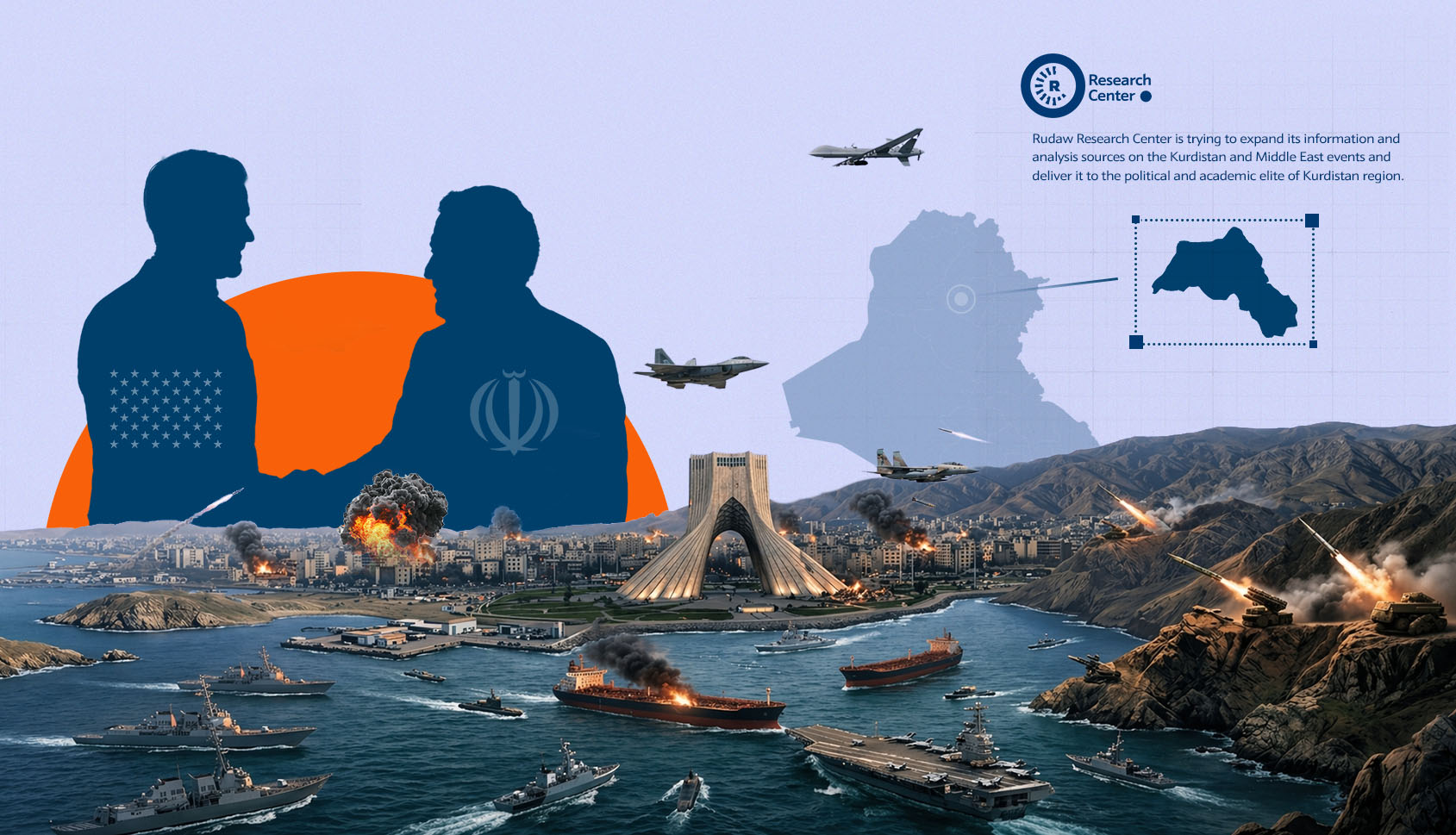
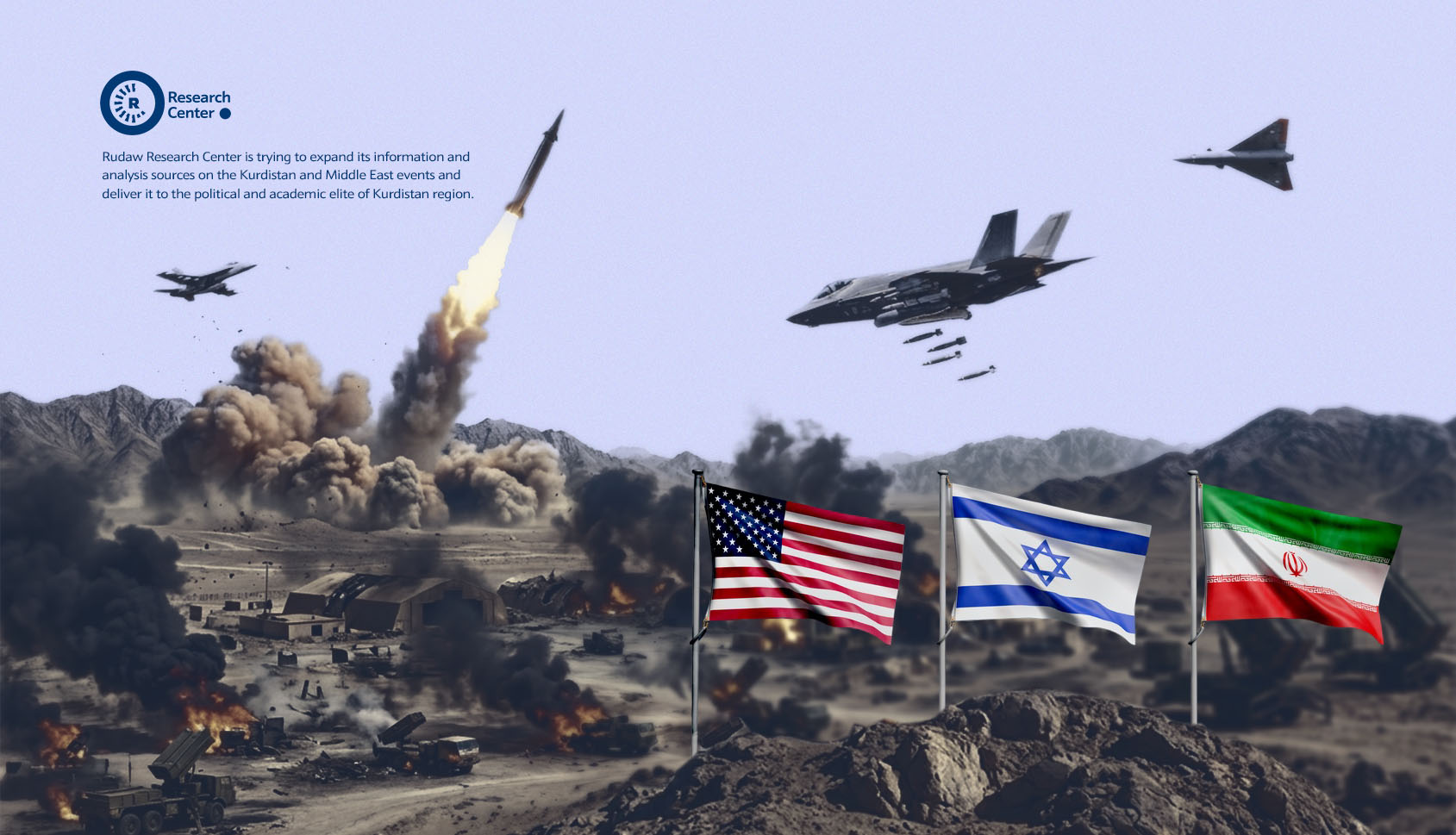
Since last Thursday, following Israeli and U.S. strikes on Iran and Tehran’s retaliatory attacks on U.S. military bases in the region, tensions have escalated sharply. Threats against oil ships transiting the Strait of Hormuz — including the reported targeting of a ship — have further heightened concerns. The situation has reached a point where a complete shutdown of ship traffic through the strait is now being discussed as a real possibility.
Oil Export through the Strait of Hormuz
Approximately one-fifth of the world’s total oil exports pass through the Strait of Hormuz each day, underscoring its strategic importance to global energy markets. According to data from S&P Global and Kpler, Iraq ships about 3.32 million barrels per day of crude oil and 310,000 barrels per day of petroleum products through the strait. This places Iraq second only to Saudi Arabia in terms of export volumes routed through Hormuz to international markets.
Geographically, the Strait of Hormuz is about 54 kilometers wide at its narrowest point, while the designated shipping lane for oil ships is only around 3.7 kilometers wide in each direction. In 2025, the combined flow of crude oil and petroleum products through the strait reached approximately 19.87 million barrels per day, representing roughly 25% of global oil trade. If tensions were to result in a closure, only an estimated 3.5 to 5.5 million barrels per day could be rerouted through alternative export channels, significantly limiting the world’s ability to offset the disruption.
Although energy analysts consider a full and prolonged closure unlikely, even a temporary disruption would have serious consequences for global energy markets, potentially triggering supply shortages, price volatility, and broader economic repercussions.
Graphic 1: Daily volume of crude oil and petroleum product exports through the Strait of Hormuz, 2025
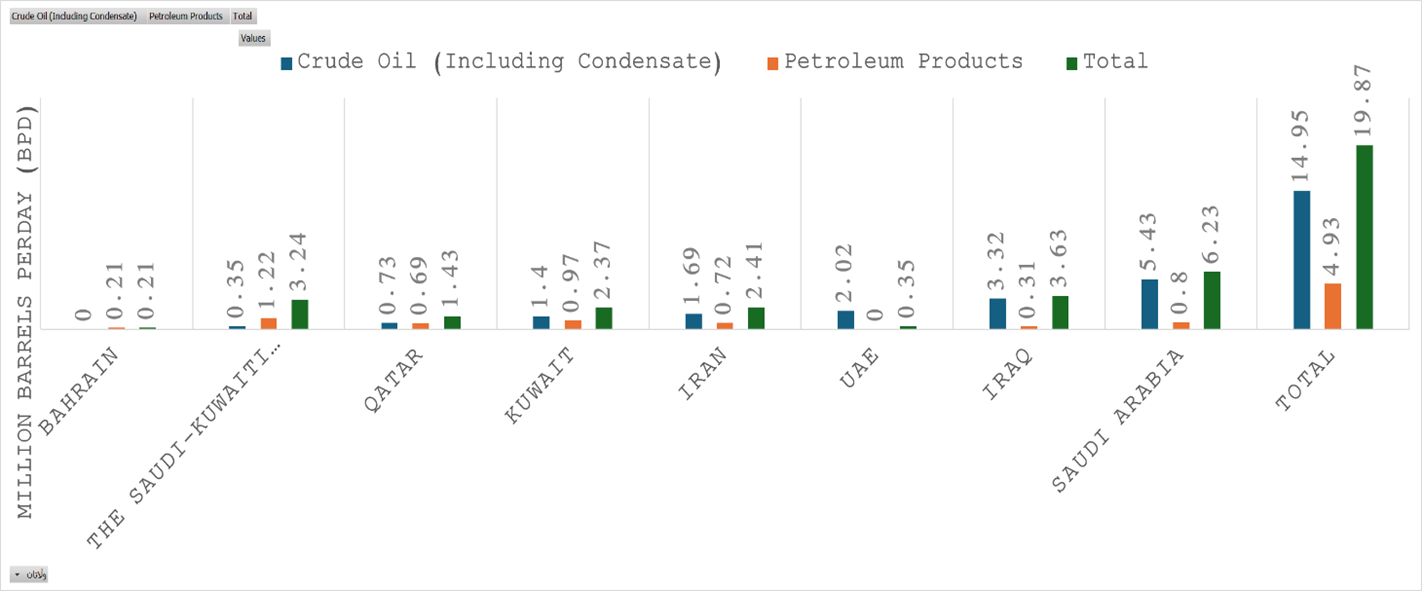
Source: Kpler and International Energy Agency, March 1, 2026. Figures represent the total average daily exports for 2025.
An equally critical dimension of the Strait of Hormuz concerns not only crude oil shipments but also natural gas liquids, particularly Liquefied Natural Gas (LNG). Unlike crude oil, LNG exports routed through the strait have virtually no viable alternative pathways. As a result, any disruption would significantly affect the global LNG market, through which roughly 19% of worldwide trade flows via Hormuz.
Graphic 2: The Strait of Hormuz and Key Ports, Pipelines, and Maritime Routes
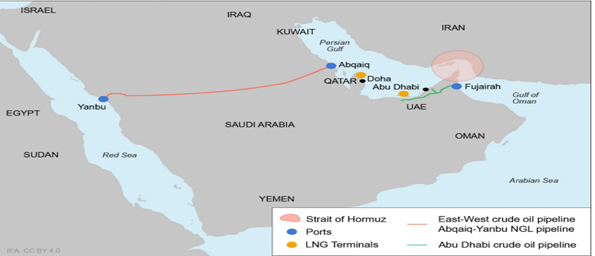
Source: International Energy Agency, March 1, 2026.
Such a disruption would have direct consequences for electricity generation in countries that depend heavily on LNG imports from Qatar and the United Arab Emirates. Approximately 93% of Qatar’s LNG exports and 96% of the UAE’s are transported through the Strait of Hormuz, with no practical alternative export routes currently available. A closure would therefore leave LNG-importing countries — particularly those reliant on it for power generation — highly exposed to supply shortages.
The Implications of the Closure of the Strait of Hormuz on the Global Oil and Gas Market
In the event of a complete shutdown of the strait, global oil supplies could contract by roughly 25%, while LNG supplies could decline by approximately 19%. This would deliver a severe shock to international energy markets, compounding the impact of ongoing geopolitical tensions. The consequences would likely include sharp increases in oil prices, revenue losses for exporting countries unable to reroute supplies, disruptions to electricity generation in LNG-dependent economies — such as Pakistan — and rising costs for gasoline and petrochemical products worldwide.
Iraq would be significantly more vulnerable than Saudi Arabia in the event of a closure of the Strait of Hormuz. Unlike Saudi Arabia, Iraq lacks viable alternative export routes — not even sufficient capacity to reroute half of its current export volumes, let alone all of them. Saudi Arabia and the United Arab Emirates, by contrast, have developed pipeline infrastructure that allows them to bypass the strait. Saudi Arabia operates pipelines linking its oil fields to ports on the Red Sea, while the UAE exports crude through the Fujairah pipeline, which terminates outside the Strait of Hormuz.
Other Gulf producers — including Iraq, Kuwait, Qatar, Bahrain, and even Iran itself — have little to no meaningful alternative routes, leaving them heavily exposed to any disruption in the waterway.
The implications of a closure would extend beyond producers to major consumers, particularly in Asia. Of the oil transiting the Strait of Hormuz each day, approximately 4.6 million barrels are destined for China, and another 6.2 million barrels for other Asian countries. In comparison, only about 1.3 million barrels per day are shipped collectively to Europe, the U.S., and Africa. This geographic concentration means Asian economies would bear the brunt of any supply shock.
From a market perspective, a closure would likely trigger an unprecedented surge in oil prices. In addition to the potential 25% reduction in global oil supply caused by a shutdown of the strait, the large reserve oil volumes that helped stabilize markets during previous crises may be less effective this time. In past disruptions, countries such as Saudi Arabia were able to draw on spare production capacity and stored reserves to offset supply losses. However, in this scenario, Saudi exports themselves would be directly constrained, limiting the kingdom’s ability to play its traditional stabilizing role in global oil markets.
Iraq’s Vulnerability Due to the Lack of Alternative Oil Export Routes
With the risk of a full closure of the Strait of Hormuz rising, Iraq would likely be the first country to face severe consequences in terms of exporting its oil to global markets. The vast majority of Iraq’s crude exports are shipped through the Strait of Hormuz, making it the country’s primary — and effectively indispensable — export route.
A complete shutdown of the strait could cost Iraq more than $200 million per day in lost oil revenue. As the threat to ship traffic increases and uncertainty persists, Iraq’s oil income would decline sharply, placing unprecedented pressure on the country’s public finances, which are heavily dependent on energy revenues.
According to the latest report from the State Organization for Marketing of Oil (SOMO), Iraq’s oil exports averaged 3.53 million barrels per day in February 2026. Of that total, approximately 3.33 million barrels per day were shipped through the Strait of Hormuz, while only about 198,000 barrels per day were exported via the Turkish port of Ceyhan.
If the situation persists, Iraq’s only remaining outlet for oil exports would be the Turkish port of Ceyhan. At present, however, this route carries only around 200,000 barrels per day from fields in the Kurdistan Region via the pipeline to Fishkhabour. Although the pipeline’s technical capacity is estimated at 1 million barrels per day, current flows are far below that level. Even if Iraq were to fully utilize this route, it would still be unable to export roughly 72% of its current oil production. Such a shortfall would sharply reduce export volumes in March 2026, deepening the fiscal strain the country is already experiencing due to relatively low oil prices, where revenues have struggled to cover public spending obligations.
This scenario would expose a deeper structural weakness in Iraq’s economy. Over the past decade, instead of diversifying its revenue base, Iraq has become even more dependent on oil. Oil revenues accounted for about 78% of total government income in 2015; by 2024, that figure had risen to 91.2%. A disruption in exports through the Strait of Hormuz would therefore not only create an immediate financial shock but also magnify long-standing vulnerabilities in the country’s economic model.
The coming days — particularly by the end of March 2026 — will provide a clearer picture of the risks and potential damage associated with a closure of the Strait of Hormuz. The consequences of a full shutdown for the transportation of crude oil, petroleum products, and gas would be profound, especially for oil-producing countries that depend heavily on this route. The global energy market would quickly reflect the scale of such disruption.
On the first day of the recent escalation, the International Energy Agency (IEA) announced that it was closely monitoring developments affecting energy security. The agency sought to reassure oil-consuming nations and its member countries that they hold approximately 1.4 billion barrels of emergency oil stocks that could be deployed if necessary. However, these reserves would not compensate for a complete and prolonged closure of the Strait of Hormuz. Strategic stockpiles are designed to cushion temporary disruptions, not to replace a sustained loss of roughly a quarter of globally traded oil. Moreover, because the U.S. and Europe receive a relatively small share of their oil imports through the strait compared with Asia, the burden of disruption would fall unevenly across regions.
To conclude, in broader terms, the recent developments in energy markets — unfolding alongside political shifts and military confrontations — mark a critical moment for global energy security. They have once again exposed the vulnerabilities and structural imbalances of both producing and consuming countries. At the same time, the crisis is likely to accelerate discussions about diversifying export routes and reconfiguring energy supply chains from producers to end markets.