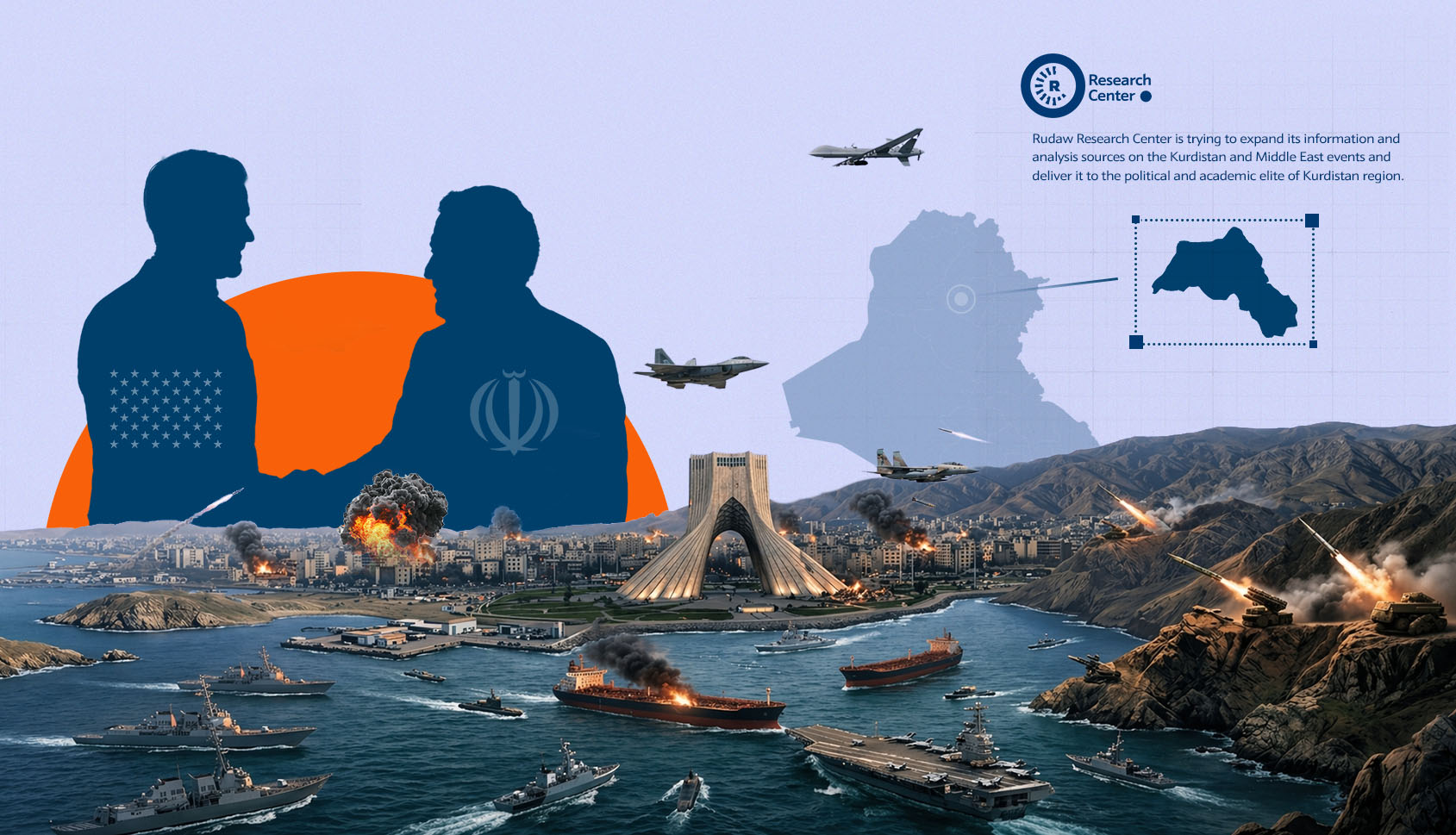

McDowall once described the geography of the Kurdistan Region as a line of geopolitical friction situated between three regional power centers: the Mesopotamian plains, the Anatolian highlands, and the Iranian plateau. His argument suggests that whenever these powers come into wars and conflicts, Kurdistan is inevitably drawn into the flames of war. In reality, this pattern is not new; it has characterized earlier historical confrontations, including those between Persia and Rome, as well as Iran and Greece. The Iranian war of 2026 has once again demonstrated that geography can, at times, shape outcomes more decisively than political decision-making alone.
Quantitative and Qualitative Analysis of the Attacks
As clearly observed, attacks on the Kurdistan Region have unfolded across two distinct phases, though a broader pattern of peaks and troughs persists throughout. These fluctuations in attack frequency may partly reflect a lack of coordination between Iran and its affiliated groups. At the same time, they underscore the sustained capacity and willingness of these actors to target the Kurdistan Region.
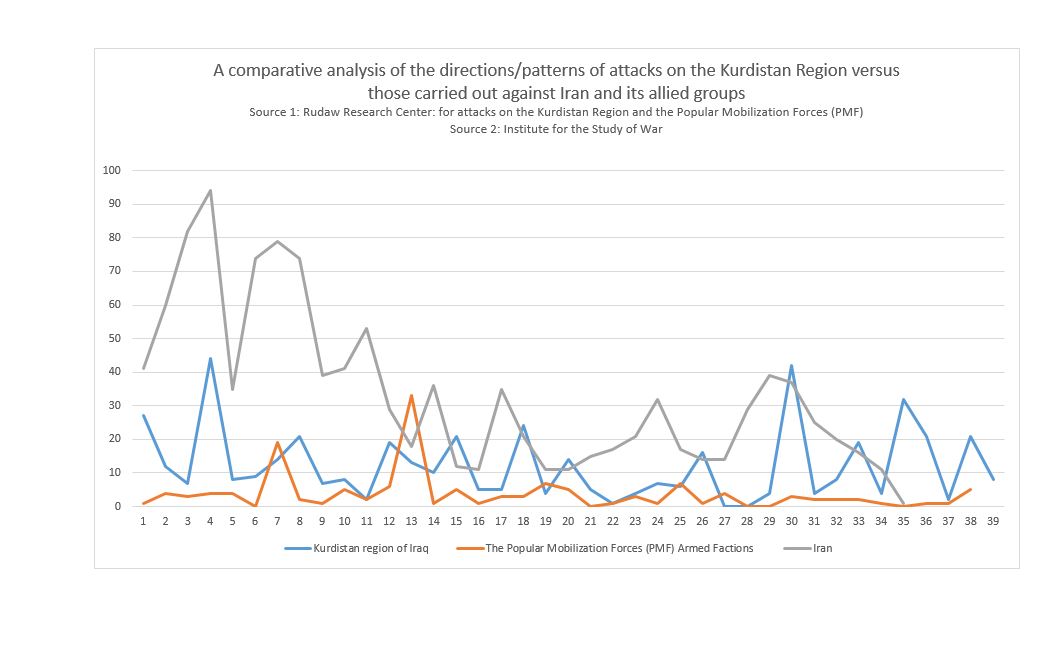
A clear correlation can be identified: whenever the United States and Israel intensify their strikes against Iran, attacks on the Kurdistan Region increase correspondingly.
During the first week—when discussions of a potential ground operation against Iran were at their peak—121 attacks were recorded against the Kurdistan Region. Over the following three weeks, however, the weekly number dropped below 80, and by the fourth week fell to as low as 34. This decline may be attributed to the intensified American and Israeli strikes targeting armed groups and Popular Mobilization Forces units. These strikes numbered 35 in the first week of the war but rose to a total of 110 over the subsequent three weeks. Additionally, increased measures by the Baghdad government against some of these groups may have contributed to the temporary reduction.
Attacks on the Kurdistan Region increased significantly in these latter phases, particularly from the fifth week onward, when talk of a possible expansion of the war once again intensified, rising to 113 attacks, and in just four days of the sixth week alone reaching 53.
Among the 13 countries and territories targeted by Iran and its affiliated groups during the 2026 war thus far, the Kurdistan Region ranks among the six most heavily targeted, alongside the UAE, Saudi Arabia, Kuwait, Qatar, and Bahrain. The Iranian army and the Revolutionary Guards have claimed responsibility for at least 10 attacks. In addition, at least five armed groups have announced strikes against the Kurdistan Region, including Kata'ib Hezbollah, Saraya Awliya al-Dam, Ashab al-Kahf, Jaysh al-Ghadhab, and Awliya Allah. It is worth noting, however, that some of these names may function as aliases intended to obscure the identity of the actual perpetrators.
Targets of the Attacks
Media coverage of these attacks has followed two distinct patterns: first, officially announced and widely reported incidents; and second, those deliberately downplayed or withheld, particularly during the early stages of the war, in an effort to prevent escalation and reduce further targeting of the Kurdistan Region.
For example, the headquarters of President Barzani has reportedly been struck at least five times, yet these incidents have not been publicly disclosed. Similarly, Turkish bases in Bamerni, near the border of Dohuk Governorate, have been attacked at least twice but received minimal media attention. This selective reporting has contributed to inconsistencies in the overall figures regarding the number of attacks.
According to data compiled by the Rudaw Research Center from February 28 to noon on April 7, 2026, at least 474 missiles and drones have been launched toward the Kurdistan Region. This figure excludes eight additional attacks for which the number of projectiles remains unknown, suggesting that the true total may be significantly higher. Nevertheless, the available data provides valuable insight into the direction, scale, and tactics of these operations.
Geographically, more than 78% of the attacks targeted Erbil, 16% Sulaymaniyah, and approximately 5% Dohuk. The remaining strikes hit areas outside the formal administrative boundaries of these governorates, such as Makhmur. In total, 28 distinct locations in Erbil, 11 in Sulaymaniyah, 10 in Dohuk, one in Halabja, and three within Nineveh Governorate have been targeted.
Kata'ib Hezbollah, one of the so-called “resistance” groups, has explicitly declared its intention to increasingly focus on the Erbil area. Of the 474 recorded drones and missiles, 37% had unknown intended targets—either because they were intercepted or failed before reaching their destination. However, 33%—amounting to 156 strikes—landed in or near civilian areas. To date, 16 people have been killed and more than 90 injured.
Furthermore, 18% of the total drones and missiles targeted camps belonging to Eastern Kurdish political parties (Rojhelat), where civilians and families were also present. Of the 86 projectiles aimed at these groups, 45% targeted Komala within Sulaymaniyah, 44% the Kurdistan Democratic Party of Iran, and 8% the Kurdistan Freedom Party (PAK), with the remainder striking the Khebat Organization. Notably, no Iranian attacks against the Kurdistan Free Life Party (PJAK) have been recorded. This discrepancy may be explained by differences in defensive coverage: in Erbil, a higher interception rate results in more attacks with unidentified targets, whereas in Sulaymaniyah, fewer projectiles are intercepted.
Of the total 474 drones and missiles, 12% were directed at eight military targets. Among these, at least five bases belonging to the Kurdistan Regional Government’s Peshmerga forces were struck, despite having no involvement in the war. This strongly suggests that these attacks were deliberate rather than accidental.
In essence, the Iranian war forms part of a broader effort to reshape the region’s evolving security architecture. As argued in a previous analysis, the Kurds now face a historic crossroads: whether to maintain a fragile balance or to realign with one of the region’s competing power blocs. The future of the Kurdish cause will largely depend on this strategic choice.
Recent developments—including the situation in Syrian Democratic Forces (SDF)-controlled areas in January, as well as the positioning of the Kurdistan Region and East Kurdish political parties throughout the 2026 war—demonstrate that neutrality in the Middle East’s great power competition is exceedingly difficult to sustain. Yet aligning with any side carries significant risks.
This is the fundamental paradox imposed by geography on Kurdistan: a land endowed with opportunity, yet equally burdened with vulnerability.