
Overview
As the war continues to escalate, Iraq and the Kurdistan Region have not only been caught in the geopolitical crossfire but are also facing growing threats to the very foundations of their economic stability. Oil exports remain the backbone of both Iraq’s national economy and the Kurdistan Region’s fiscal revenues. Yet the ongoing conflict is increasingly exposing structural vulnerabilities across the country’s energy sector. These vulnerabilities extend beyond the physical security of oil fields and export terminals to include the reliability of domestic transportation infrastructure, the safety of maritime routes, and the limited availability of alternative export corridors to global markets.
The State Organization for Marketing of Oil (SOMO), Iraq’s official crude marketing authority, regularly publishes detailed data on crude oil export volumes and shipping routes. These reports track exports departing from Iraq’s main terminals in southern Iraq—primarily Basra Oil Terminal and other facilities connected to the ports of Basra and Umm Qasr—as well as shipments routed through the Iraq–Turkey pipeline to the Mediterranean port of Ceyhan. However, the overwhelming majority of Iraq’s crude exports originate from southern terminals and must pass through the Strait of Hormuz before reaching international markets. In practice, roughly 95 percent of Iraq’s exported crude relies on this maritime chokepoint, while only about 5 percent has historically been transported through alternative routes that bypass the Strait.
Before the war, Iraq and the Kurdistan Region together produced approximately 4.65 million barrels of crude oil per day. Of this total, the Kurdistan Region accounted for roughly 300,000 barrels per day, while federal Iraq produced around 4.35 million barrels per day. Since the escalation of the conflict, however, production levels have dropped sharply. Current estimates suggest that output in federal Iraq has fallen to just over one million barrels per day, while production in the Kurdistan Region has declined to below 70,000 barrels per day. This dramatic contraction highlights the extent to which the conflict has disrupted upstream production, export logistics, and the broader operational stability of Iraq’s oil sector.
The consequences of these disruptions extend well beyond the immediate decline in production and exports caused by the closure of the Strait of Hormuz and attacks by armed groups on energy infrastructure and supply routes. While Iraq is estimated to be losing roughly $220 million in oil revenue per day, the immediate fiscal shock alone does not capture the full scale of the risk facing the sector. The Central Bank of Iraq (CBI) has indicated that its foreign currency reserves could sustain government expenditures for up to twelve months, which may temporarily cushion the impact on public finances.
However, the longer-term implications for investment in Iraq’s energy sector may be far more serious. Large-scale international energy projects are particularly sensitive to geopolitical instability and security risks. For example, the suspension or delay of just two major energy agreements—those involving BP and Total Energies, with a combined estimated value of around $52 billion—could significantly undermine future development plans. The scale of these contracts alone represents more than half of the reserves currently referenced by the Central Bank, illustrating how prolonged instability could discourage foreign investment, delay critical infrastructure projects, and ultimately weaken Iraq’s long-term production capacity.
Security risks facing Iraq and the Kurdistan Region are currently intensifying as the war involving Iran, the United States, and Israel continues to escalate. Although many of the immediate threats emerge from within Iraq itself—particularly from armed groups operating inside the country—they remain closely tied to the broader regional conflict. This environment of heightened insecurity has forced several international energy companies to suspend or scale back their operations, leading to reductions in oil and gas production as well as a sharp decline in export volumes.
At the same time, these developments are exposing deeper structural weaknesses within Iraq’s energy infrastructure, particularly in the areas of transportation and export logistics. The heavy dependence on a limited number of export routes and vulnerable transit corridors has revealed significant long-term risks for the country’s energy sector. In this context, ensuring the operational security of production facilities, pipelines, and export terminals is not only an economic necessity but also a critical requirement for safeguarding the livelihoods and fiscal stability of Iraq’s population, whose economy remains overwhelmingly dependent on oil revenues.
Oil Production Levels in the Kurdistan Region’s Oil Fields
Most international oil companies (IOCs) operating in the Kurdistan Region’s oil and gas fields have announced the suspension of production due to heightened security risks. The first to do so was the British oil company Gulf Keystone Petroleum, which halted operations at the Sheikan field. This was followed by Dana Gas at Khor Mor, and Shamaran Petroleum at the Atrushand Sarsang fields. Although Norway’s DNOhas not issued a formal announcement regarding the Tawkeand Peshkabir (Peshkhabour) fields, available information indicates that production there has also been suspended.
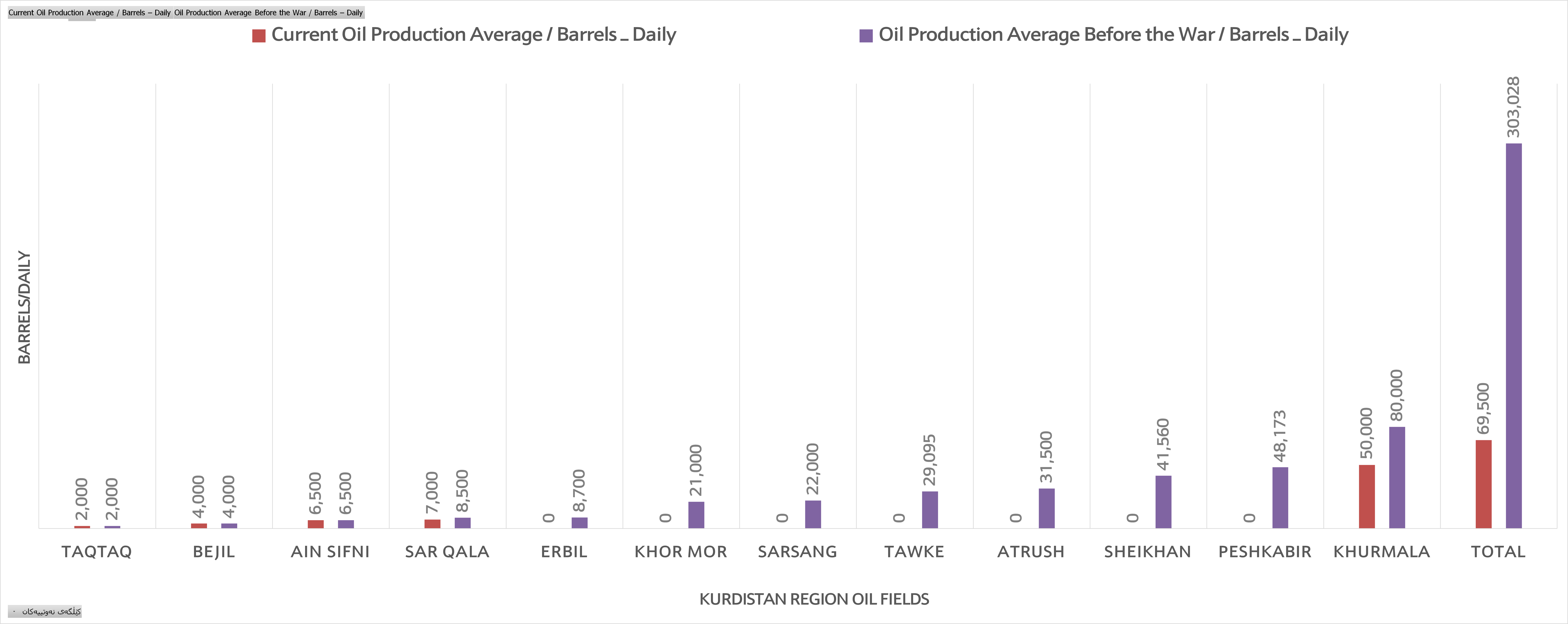
Among the Kurdistan Region’s major producing assets is the Khurmala oil field, which during this period has experienced repeated production stoppages and resumptions due to the same security concerns. Prior to the outbreak of the war, the field produced approximately 80,000 barrels per day (bpd). In recent days, however, production has fluctuated significantly—dropping to around 45,000 bpd on some days and recovering to 65,000 bpd on others. Meanwhile, fields such as Sarqala, Erbil, Bejil, and Ain Sifni have not issued official statements regarding their operational status. Nevertheless, available information suggests that they continue to operate, albeit at reduced production levels.
According to compiled data, total oil production across the Kurdistan Region’s fields—including condensate output from the Khor Mor gas field—stood at roughly 300,000 barrels per day before the war. This figure has now fallen sharply to around 69,500 barrels per day, although output continues to fluctuate considerably from day to day due to the unstable security environment.
Graph 1: Oil Production Levels in Kurdistan Region Fields before the War and at Present
Sources: Company Q4 2025 reports; Iraq Oil Report; Middle East Economic Survey (MEES); Kpler.
Note 1: Output from the Khor Mor field refers to gas condensate, which has recently increased from 15,800 to approximately 21,000 barrels per day (b/d).
Note 2: Production at the Khurmala field fluctuates significantly daily. For this graph, output is presented as an estimated average of 50,000 b/d.
Volume of Oil Exports from Iraq and the Kurdistan Region via SOMO
Over the past 15 years, Iraq’s oil exports have rarely fallen to levels as low as those seen today. According to recent statements from officials at the Basra Oil Company, exports from federal Iraq have declined by roughly 2 million barrels per day, while exports from the Kurdistan Region have dropped by more than 200,000 b/d. At current prices—now exceeding $100 per barrel—this reduction translates into daily revenue losses of approximately $220 million, or nearly $1.5 billion per week.
Initially, the decline in Iraqi oil production was partly attributed to limited storage capacity and disruptions linked to the closure of the Strait of Hormuz. However, security concerns and the operational safety of international oil companies (IOCs) have since become major factors. As a result, despite a temporary easing of maritime restrictions and reports that Iran allowed shipments destined for China to pass through the Strait, Iraq has continued to curtail exports by roughly 2 million barrels per day.
These two factors—the risk to shipping through the Strait of Hormuz and the rise in attacks on international oil companies operating as contractors in Iraq and the Kurdistan Region—have combined to push Iraq’s oil production and export levels to their lowest point in a decade. As a result, export volumes have fallen sharply.
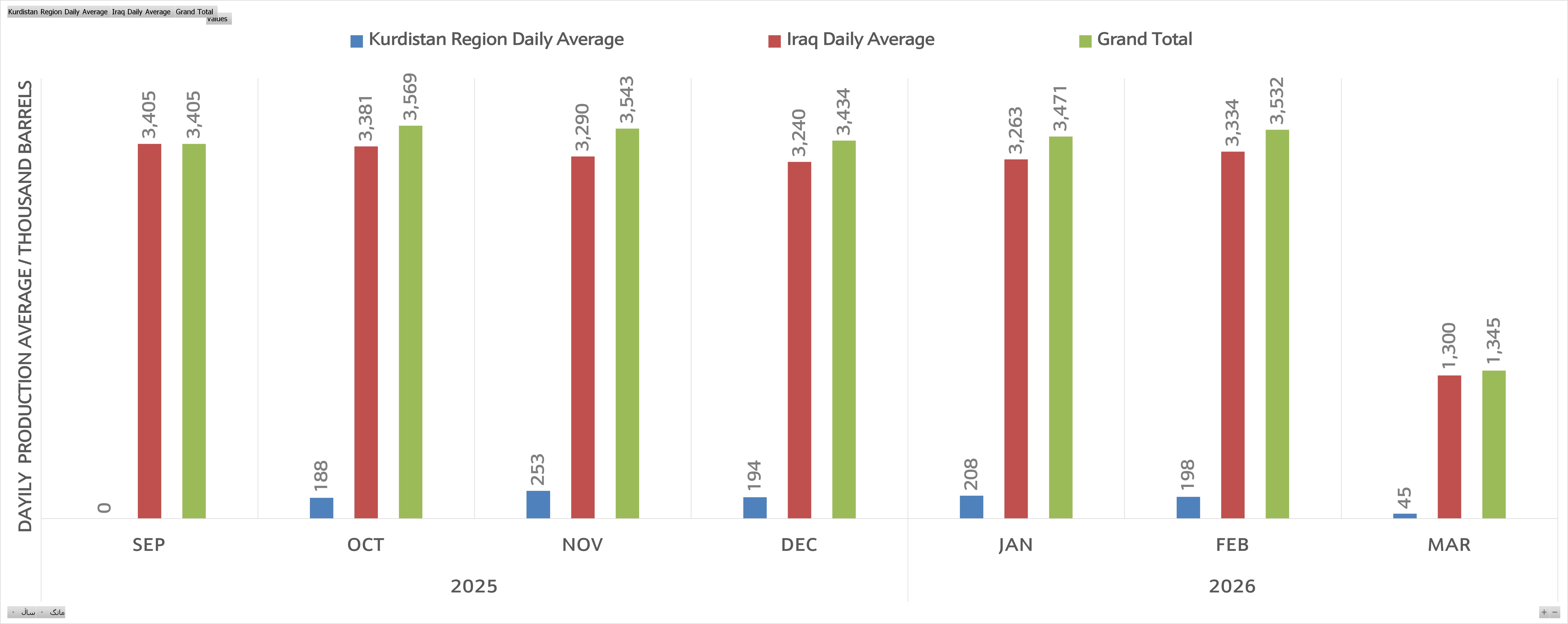
According to the latest data from Iraq’s State Organization for Marketing of Oil (SOMO), as of February 28, 2026, daily exports of the country’s three main crude streams—Basra Light, Basra Medium, and crude produced in the Kurdistan Region—totaled approximately 3.532 million barrels per day. Of this amount, around 198,000 barrels per day were exported through the Turkish port of Ceyhan from oil fields in the Kurdistan Region. The remaining 3.3 million barrels per day were shipped from Basra’s export terminals, including Basra Oil Terminal and Khor Al-Amaya near Umm Qasr. Overall, roughly 97 percent of Iraq’s oil exports rely on maritime routes passing through the Strait of Hormuz to reach global markets.
At present, discussions are underway about allowing Iraqi crude shipments to China to continue transiting the Strait of Hormuz. According to export data from the early months of this year, Iraq was shipping roughly 1 million barrels per day to China. This means that approximately 2.3 million barrels per day that would normally be destined for other international markets remain affected by the current disruption.
Graph 2: Volume of Iraq’s Oil Exports in Q4 2025 and Q1 2026
Source: Oil export volumes, State Organization for Marketing of Oil (SOMO), accessed March 6, 2026.
Note: The figure for March 2026 is based on an estimate derived from the current daily export volumes reaching global markets.
Conclusion
The continued instability affecting the energy sector in Iraq and the Kurdistan Region poses serious risks. Beyond disrupting daily life and reducing government revenues, it is also accelerating the withdrawal of international oil companies and discouraging further investment in the oil and gas industry.
At present, the economic losses are becoming substantial. The closure of the Strait of Hormuz, combined with drone and missile attacks targeting energy infrastructure in the Kurdistan Region and parts of southern Iraq, has significantly heightened operational risks for international companies. As a result, many companies have evacuated non-essential staff and temporarily suspended production activities. Under these conditions, even if maritime traffic through the Strait of Hormuz resumes, export volumes could remain severely limited due to the disruption of upstream production.
In recent years, Iraq and the Kurdistan Region have signed several major energy contracts with leading international companies. These include BP’s redevelopment agreement for the Kirkuk oil fields, projects by France’s Total Energies and the U.S.-based Chevron in Basra and Dhi Qar, as well as investments by U.S. Company HKN Energy, and the UAE’s Crescent Petroleum in the Khor Mor gas field in Sulaymaniyah. Unless the current situation is fundamentally resolved, many of these agreements risk remaining little more than commitments on paper. The uncertainty is also forcing companies to reconsider further investments in new well drilling and field development aimed at increasing production, including operations by Norway’s DNO in Duhok and the United Kingdom’s Gulf Keystone Petroleum at the Sheikan field.
The security of the Strait of Hormuz may eventually be restored, allowing Iraq to recover its export volumes. However, the greatest long-term threat to the energy sector in Iraq and the Kurdistan Region lies elsewhere: the activities of armed militias. In the past, such groups primarily threatened energy infrastructure in the Kurdistan Region. Today, however, they are targeting Iraq’s most valuable asset—its southern oil infrastructure, including the Rumaila oil field. Rumaila, which holds an estimated 17 billion barrels of recoverable reserves and has historically produced around 1.4 million barrels per day, is operated by BP and PetroChina in partnership with the Basra Oil Company. Attacks on such facilities could inflict far more lasting damage than the temporary daily losses caused by disruptions in the Strait of Hormuz. While alternative export routes—whether through tankers, the rehabilitation of older pipelines, or the construction of new pipeline corridors—can be developed over time, restoring lost foreign investment worth billions of dollars would be far more difficult.
Ultimately, the war also exposes a deeper structural weakness: the absence of a coherent national energy strategy and the fragility of Iraq’s energy infrastructure. The current situation reflects a striking imbalance. In central and southern Iraq, vast oil reserves exist but lack sufficient transportation pipelines or alternative export routes beyond the Strait of Hormuz. In contrast, the Kurdistan Region possesses an export pipeline capable of transporting roughly one million barrels per day and access to the Mediterranean export terminal at Ceyhan, yet it currently lacks sufficient production flows to fully utilize this capacity. This contradiction highlights a fundamental gap in the strategic planning and industrial infrastructure of Iraq’s oil and gas sector—an industry upon which the country’s entire economy ultimately depends.