
The 2026 Iran War is one of those events with the potential to reshape the geopolitical landscape of the second quarter of the 21st century in the Middle East, while simultaneously transforming the contours of the Kurdish issue. Although the war has not formally concluded, the United States and Iran remain suspended in a limbo between a "cold peace" and the prospect of a return to military confrontation. Whatever the outcome of this standoff, the forty-day conflict has already left its foundational imprints behind — in such a way that neither a future Iran will revert to its pre-war state, nor will the regional balances remain as they once were.
In this equation, the Kurds emerged as an involuntary party to the war — and this, paradoxically, despite their formal declaration of neutrality. In truth, for a geography like Kurdistan, neutrality is not a choice that can be determined solely by internal will; it requires the recognition and endorsement of international and regional actors alike. Yet the trajectory of events made clear that this neutrality was — and remains — incompatible with the interests of either camp in the conflict.
Against this backdrop, the situation of the Kurdistan Region and the Kurdish issue in the east is moving toward a new and distinctly different phase.
Kurds in the War Strategy of United States and Israel
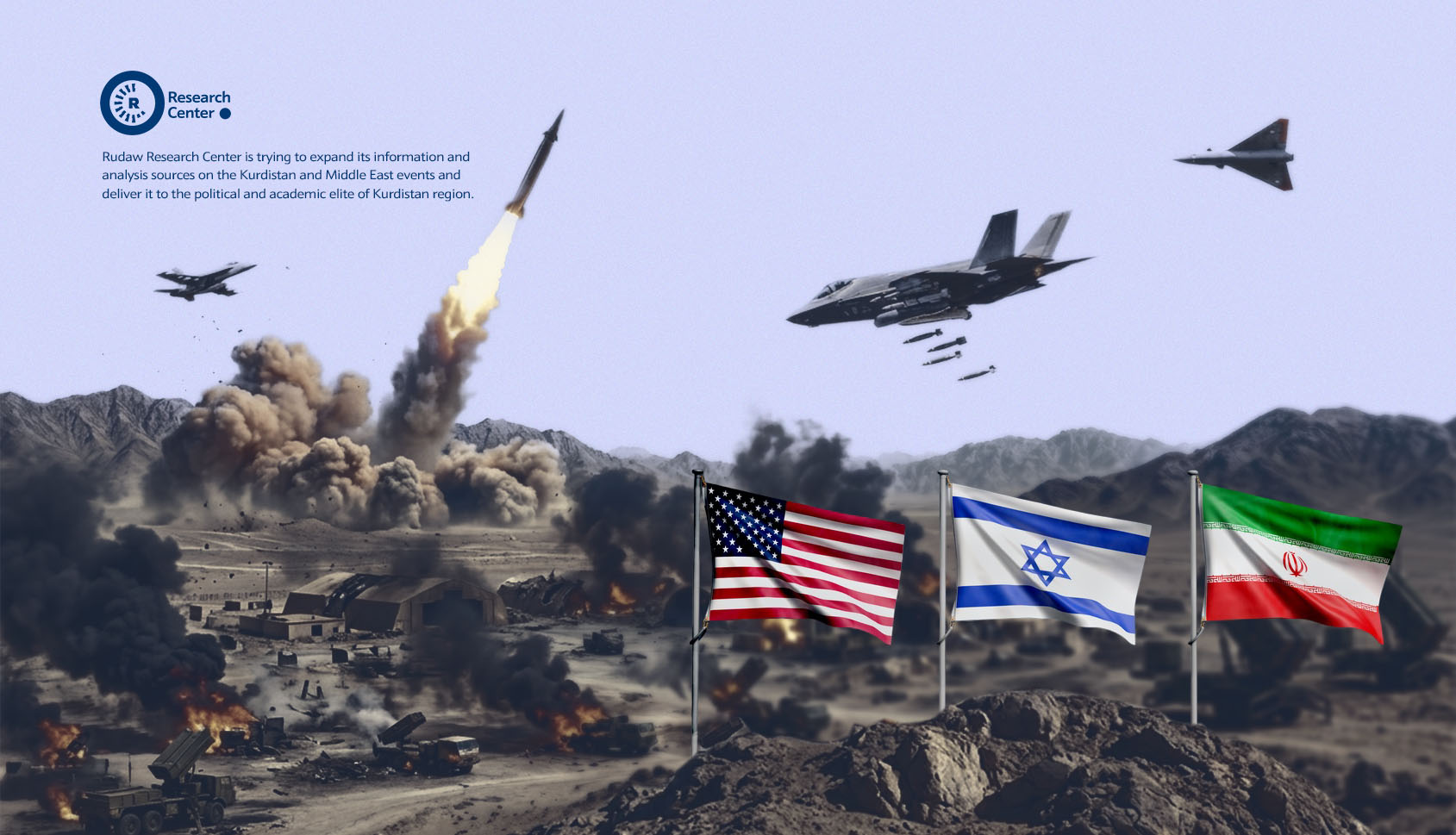
America weakened Iran during the forty-day war, but was unable to finish it off entirely. Although the American-Israeli front holds air superiority and intelligence dominance, their core strategic objectives remain unachieved — among them the elimination of 440 kilograms of uranium enriched to 60%, the degradation of missile capabilities, and the dismantling of regional influence. Nor has the political regime undergone any change.
U.S. Central Command (CENTCOM) has itself referenced striking more than 13,000 targets inside Iran, and from the very opening of the war, the question of opening a Kurdish military front became a subject of considerable media speculation. In reality, however, this was far more a tactical deception aimed at Iran than any fully formed military plan seriously intended for execution. It may equally have served as a mechanism to deter Turkey from directly aiding Iran — by leaking this information, a portion of Iranian military attention was drawn toward the land frontier, only for it to emerge, forty days later, that no operational plan of that nature had ever existed.
At its core, the very act of leaking this subject through American media was itself the signal that it was a deception plan rather than a genuine offensive. Had there truly been a military plan to employ the Kurdish front as a theater of war, it would have been executed in complete silence. The fact that this matter was discussed with several distinct Kurdish actors — if accurate — only confirms that Washington never intended to act on it, even if it raised the subject; for to share a "secret" plan with multiple parties holding divergent ideologies, interests, and regional relationships is, by definition, to ensure its deliberate exposure. At the same time, and contrary to certain media propaganda, Trump had never personally spoken with any leader of the eastern Kurdish parties on this matter.
Any operation aimed at opening a Kurdish front against Iran would have required an intensive and sustained air campaign over Kurdish-populated areas. While the strike data does show this occurred to a degree, it took place within the broader framework of degrading Iran's overall war-fighting capacity and administrative capability — not as something specifically targeting Kurdish-populated regions.
According to ACLED data covering the period from February 28 to April 11, a total of 2,958 explosion and remote violence incidents were recorded across 32 locations inside Iran. Based on analysis of that data, an estimated 86% of these are attributable to drone, missile, and aerial strikes.
Of the total strikes, only 8.85% occurred across the four Kurdish-populated provinces of Kermanshah, Ilam, Kurdistan (Sanandaj), West Azerbaijan, and (Urmia) — while 21% of strikes took place across 8 locations in southern Iran. Tehran alone absorbed 31% of all bombardment, more than any other location, with the central Iranian regions accounting for a further 17%.
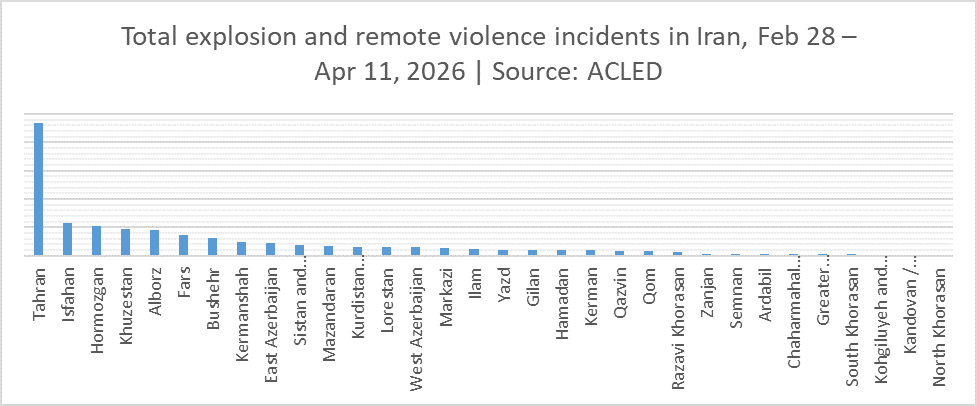
On the first day of the war alone, 553 strikes were launched against Iran — of which only 25 fell across the four Kurdish-populated provinces, with nearly half of those concentrated in Kermanshah. This is broadly attributed to the presence of at least five significant missile sites in that province.
At the time, Iran's then-Supreme Leader Ali Khamenei had spoken of the concept of "bristling mountains" — a reference to the strategic value of mountainous terrain for the placement of missile sites, air defense systems, and offensive infrastructure. Given that the Zagros mountain chain runs through Kurdish-populated areas before descending southward into the Iranian interior, these regions were inevitably embedded within the military-strategic calculus of Iran, the United States, and Israel alike.
Beyond the objective of degrading Iran's military capabilities, the leaking of the Kurdish front narrative may have carried an additional purpose: the deliberate complication of Erbil-Baghdad relations. Undoubtedly, one of Iran's primary objectives was to leverage the armed factions of the "Islamic Resistance in Iraq" against American and Israeli interests — yet their preoccupation with the Kurdish front question diminished their capacity to do so effectively. According to government figures, from February 28 to April 20 of this year, 809 drones and missiles were directed at the Kurdistan Region, of which approximately 87% were drones — a significant portion of which were launched from within Iraqi territory itself.
Preventing Turkish-Iranian cooperation may well have been yet another objective of this deception tactic. Turkey was, if anything, more anxious about the Kurdish armed movement than Iran itself. Ankara undoubtedly views a weakened Iran as being in its own interest — yet it has no desire to see Israel emerge as the dominant power of the region. For this reason, Turkish cooperation with Iran during the war was entirely foreseeable. Here, it appears that America and Israel deliberately weaponized Turkey's sensitivity toward the Kurdish issue as a preemptive card — one that, in practice, inhibited Ankara from openly siding with Tehran throughout the conflict.
Keeping the Kurdish issue alive as an active issue during the cold peace phase remains a strategic necessity for Washington. The silence of air defense systems in the face of a considerable portion of the more than 30 strikes carried out against the bases of eastern Kurdish parties since the ceasefire is itself a signal of American intent — a deliberate policy of "tension management" with Iran, using these strikes as a calibrated pressure valve.
Within this context, the Kurdistan Region becomes a pivot of balance — not only for the United States, but for the Gulf states and Turkey alike — as a counterweight against the dominance of armed factions in Iraq. Turkey anticipates deepening friction with Israel and may therefore seek to cultivate a closer and more developed relationship with the Kurds as a strategic hedge in the period ahead.
The Kurdish Front and Iran’s Calculations
Both the Kurdistan Region and the Iranian opposition Kurdish parties found themselves embedded within the strategic core of the war — and its aftermath. The conflict has driven the "Kurd-Iran-Baghdad" relationship into a phase of acute complexity, while simultaneously generating unprecedented pressure on the Kurds from multiple directions.
In reality, the question of a ground offensive and the prospect of Kurdish forces advancing into Iran served, from the very outset, as a highly useful propaganda asset for Tehran as well — one that could be exploited to inflame nationalist sentiment among its own base, particularly within Persian and Azerbaijani constituencies, while simultaneously stirring a sense of pan-Shia solidarity across Iraq and the broader region.
This may also explain another dimension of Iran's continued strikes against eastern Kurdish party bases even after the ceasefire and amid ongoing negotiations with the United States. Keeping that threat alive — keeping the image of the Kurdish armed adversary vivid and present — may be precisely the instrument Tehran requires for the post-war phase as well: a renewable source of internal mobilization, a justification for continued military posturing, and a pressure lever that costs Iran relatively little while extracting a consistent toll from Kurdish political and security stability.
If the war does not resume, the prospect of renewed protests and the emergence of open fractures within the ruling elite is far from implausible — much as occurred in the aftermath of the 12-day war of 2025. The Iranian government has officially acknowledged $270 billion in war damages, a figure that exceeds half of the country's gross national income — a staggering threshold by any measure. The International Monetary Fund has projected that the Iranian economy will contract by at least 6%, while Iran's own figures, even in their most optimistic scenario, speak of an inflation rate exceeding 50% by year's end — a number that, anywhere in the world, would be regarded as fertile ground for popular discontent, and particularly so in peripheral and marginalized regions.
The dynamics of Iran's internal power struggle remain unclear, yet certain signals suggest the path ahead may not be entirely smooth. At this juncture, one observation stands above all others: during the war, the question of regime survival filled much of the fault lines between Iran's ruling factions — reformists and conservatives, clerics and military commanders alike. But there is no guarantee this will remain the case now that the conditions of war have receded.
What is particularly striking is that since the ceasefire, Tehran has been navigating between two contradictory impulses simultaneously — on one hand seeking a settlement, and on the other hardening its positions. Although the American-Israeli front held air superiority and intelligence dominance throughout the war, their core strategic objectives remain unachieved: the elimination of 440 kilograms of uranium enriched to 60%, the degradation of Iran's missile capabilities, and the dismantling of its regional influence are all still intact, and the political regime itself stands unchanged. This is to say nothing of the fact that a ceasefire has been reached and some form of negotiation remains ongoing. It is precisely this reality that may have produced a perception among Iran's ruling elite that the existential threat to the regime has passed — and that, with that threat lifted, a degree of internal disagreement can once again be tolerated, even normalized.
During the Islamabad negotiations, the Fars News Agency published a brief but telling report stating that Hossein Taeb — formerly commander of the IRGC's intelligence apparatus — had obstructed the negotiating team, accusing them of being "prepared to give everything away without receiving anything in return." In the wake of the criticism directed at the negotiating team, Mohammad Bagher Qalibaf, Speaker of the Iranian Parliament, gave a television interview asserting that Iran had not retreated from its demands, while acknowledging that the United States and Israel hold military superiority and greater experience — though insisting that their strategy had been flawed and that Iran had ultimately proven more effective.
The Entekhab website reported that the Paydari Front and supporters of Saeed Jalili refused to sign a parliamentary statement in support of Qalibaf and the negotiating team. Within the same climate, both Raja News and Tasnim Agency published pieces directed against one another — a phenomenon that remains relatively rare within Iranian state media. When Foreign Minister Araghchi raised the possibility of reopening the Strait of Hormuz, he was subjected to a substantial wave of media attacks — this in addition to the persistent anti-Rouhani and anti-Zarif rhetoric that continues to circulate within the country.
Time will tell whether these signals harden into a deeper power struggle or remain transient — but taken together with the political and economic pressures of the war, they create precisely the conditions in which keeping the eastern Kurdish parties as a live issue serves a dual function for Tehran: providing a security justification for the continued militarization of Kurdish-populated provinces — regions historically predisposed to protest and dissent — while simultaneously deploying the specter of "Kurdish separatism" as an instrument for suppressing discontent elsewhere, redirecting popular frustration outward toward a manufactured threat rather than inward toward the regime itself.
Regarding the eastern Kurdish forces, Tehran will initially attempt to expel them from the Kurdistan Region along the lines of the Mojahedin-e Khalq (MEK) model — removing an armed opposition from the territory of a neighboring state through a combination of diplomatic pressure and security arrangements. However, in the post-war environment, there is a meaningful probability that Iran will find itself compelled to pursue an altogether different course. Two alternative paths present themselves. The first is a return to a renewed security arrangement with both Baghdad and the Kurdistan Regional Government. The second is a negotiated settlement more closely resembling the model that has evolved between Turkey and the PKK.
Should the war not resume, Iran will in all likelihood attempt to deepen its influence within Iraq — yet this ambition confronts considerable headwinds. Iraq stands as the primary collateral casualty of the Iran-America confrontation, and it remains uncertain whether the country can bear the full cost of that role much longer. It is broadly anticipated that once a new government is formed, Baghdad will move toward a softer posture with Washington and will be compelled to reorder its relations with Erbil on both economic and political grounds.
Although a sense of pan-Shia solidarity surged during the war, this is fundamentally a transient phenomenon. Iran's previous financial patronage of Iraqi factions has contracted significantly, leaving the relationship increasingly reliant on ideological and religious bonds alone — a foundation that cannot indefinitely absorb the waves of domestic discontent that may intensify with the arrival of summer and its attendant economic pressures. The prospect of Iraqi Shia detachment from Iran — reminiscent of the Tishreen protest movement — therefore remains a powerful and credible scenario.
It is precisely at this juncture that Iran's economic and political dependence on the Kurdistan Region reasserts itself.
The Kurdistan Region could represent a significant opportunity for Iraq as well — a channel through which to manage its relationships with the United States and the Gulf states, both of which have sustained considerable damage as a result of this war. More broadly, since 2003, Iraq has stood before a historic opening: to become a model state in its handling of the Kurdish issue — to treat the Kurds not as a threat to be managed but as a source of geopolitical reinvigoration and strategic depth. Yet the continued attacks by armed factions on the Region, interference in its internal affairs, and the politicized manipulation of the budget process and Kurdish internal divisions — tools that certain Iraqi actors may regard as calculated leverage and a useful pressure card — are systematically constructing the very obstacles that foreclose this possibility.
Iraq, operating within the framework of its 2005 constitution, could achieve a significant geopolitical resurgence through its Kurdish partnership. Instead, by emulating the approaches of neighboring states and pursuing the containment of the Kurdish issue rather than its resolution, it risks falling into a historic trap — one that may deliver yet another cycle of protracted instability rather than the regional standing it might otherwise have claimed.
Conclusions
The question of the "Kurdish front" in the Iran war is a double-edged issue that serves the interests of two opposing sides in distinctly different ways. On one hand, for the Kurdistan Region, a weakened Iran — one whose relationship with Washington remains fraught and complicated — is seen as the most favorable strategic outcome. On the other, the eastern Kurdish parties regard a fundamental transformation of the regime's behavior, or the transformation of the political system itself, as their primary objective.
On the military level, no genuine operational readiness for opening a Kurdish front existed from the outset. The Kurdistan Region, by virtue of its fragile internal conditions — budget dependency, the absence of a fully integrated air defense system, and an exposed rear flank vulnerable to attacks by armed factions — was never in a position to participate in a war of that nature.
At the same time, the experiences of Hamas, the PKK, and the Hashd al-Shaabi have confirmed for the eastern Kurdish parties as well the hard truth that entering an unplanned war brings nothing but compounded destruction to Kurdish-populated areas — particularly given that their positions and camps are fully exposed, and that since the mid-1990s they have moved away from conventional peshmerga warfare against Tehran. In all probability, the post-war phase will bring an end to the operational model that the eastern Kurdish parties have pursued across the past several decades.
On another front, the ambiguity of Donald Trump's plan for Iran — functioning as a kind of "political proverb" — cast its shadow over a wide range of actors throughout the conflict. During the protests of late last year and early this year, Trump's pledges of support for demonstrators went unfulfilled, and a significant number of people paid for that gap with their lives. It is worth noting that Kurdish participation in those protests was, by comparison with previous rounds, markedly lower — a posture broadly consistent with the position the Kurdish parties adopted during the war itself, though one that merits deeper examination.
Looking ahead, Tehran's position will remain suspended between two options: either opening the door to a political accommodation — should the Turkey-PKK negotiating model prove instructive — or adopting a harder security and military course. What is clear is that force alone is insufficient to resolve these conflicts; Kurdish movements may be suppressed in one phase, but they do not disappear, and history has demonstrated repeatedly that they re-emerge with greater force.
The 2026 Iran war has confirmed once again that military superiority alone cannot reshape the behavior of determined actors. In contemporary conflicts, even weaker parties can sustain themselves through strategies of asymmetric resistance — just as Russia has been unable to conclude the war in Ukraine since 2022, and just as Israel could not bring Hamas and Hezbollah to a definitive end in 2023 and 2024.